Closing the Gap at work: Do Not Give Up Listening
👉 [Register Here: Closing the Gap Webinar | 18 March 2026] Join Aunty Munya & Carla Rogers...
Read MoreYarning Circle Webinars Members Only Live Q&A
Subscribe
For many non-Indigenous Australians, growing up with the national anthem meant some old-timey language sung without question. But a recent proposal by NSW Premier Gladys Berejiklian has got Canberra buzzing – and kickstarted a dialogue across the country.
Composer Peter Dodds McCormick’s 1878 ode to his adoptive homeland was popular with his colonial contemporaries – those, like Dodds McCormick himself, who’d “come across the seas”.
But when it comes to recognising the oldest continuing culture in the world? falls very, very short.
– Advance Australia Fair
It’s the word ‘young’ in the above that has inspired Gladys Berejiklian’s proposal. In this context, the word is a reference to the short period of time that European settlers have been in this country, the not-quite-120 years since Federation.
But when you’re talking about the country that’s home to a culture some 100,000+ years in the making – a culture that wasn’t even acknowledged in 1878 when the lyrics were penned – ‘young’ is exposed for what it is: a slap in the face.
The lyric – or indeed the anthem itself – is not something that resonates with Evolve Co-Director and Bardi Elder Aunty Munya Andrews.
“To me, promoting youth over the wisdom of Elders is obnoxious, and telling people who are locked up in jails that they are ‘free’ is absurd,” she explains. “What does being ‘young’ and ‘free’ mean anyway?”
Co-Director Carla Rogers also struggles to identify with the song. Despite a lifelong love of singing, she notes that any situation requiring her to sing has left her feeling less joyful, more strained.
“From my earliest memory – early Primary I think – I recall feeling less than enthusiastic, definitely uncomfortable and even embarrassed about singing the anthem … it’s like the anthem is someone that you are expected to respect and uphold, but it represents so much that goes against your values.”
The song clearly has some flaws – and they’re not going unnoticed by the wider community, either. At the time of writing, an online poll by SBS showed that 86% of respondents were in favour of Berejiklian’s change.
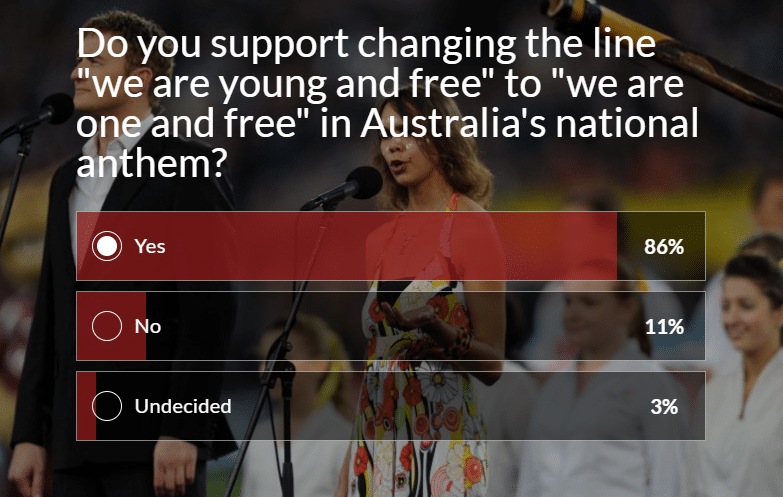
Source: SBS
The proposal also comes with the support of some of Berejiklian’s First Nations colleagues. Minister for Indigenous Australians Ken Wyatt, Yanyuwa Senator Malarndirri McCarthy and Wiradjuri MP Linda Burney have all voiced their agreement. However, not all are in favour.
Gunnai and Gunditjmara Senator Lidia Thorpe is one critic, noting that “We will need to do more than change the national anthem, we need to change the nation.”
It’s great that the NSW Premier is talking about ensuring that First People are considered in this nations identity. We will need to do more than change the national anthem, we need to change the nation. https://t.co/O61y0fRql7
— Lidia Thorpe (@lidia__thorpe) November 11, 2020
And national change is definitely necessary. While some good work is being done, this year’s Closing the Gap report has made it clear that there is still a tremendous gulf between outcomes for Aboriginal and Torres Strait Islander people and their non-Indigenous counterparts.
Then, there’s the issue of the new lyric itself. While it might be an improvement on the original, a deeper dive into Berejiklian’s suggestion reveals its flaws.
“What does we are ‘one’ mean?” reflects Aunty Munya. “Is that a One Nation thing?”
“The truth of the matter is we are NOT one – there is great dissension and divisiveness among us.”
It might be hard to imagine how we would go about changing a national anthem, but it’s possible – in fact, the version sung today is actually slightly different to the version first written.
The original, 1878 lyrics began with sonsand were altered under Bob Hawke’s leadership to the more inclusive all
What if we were given free rein to choose our own lyrics to the anthem? What would those be?
In 2009, Yorta Yorta musician Deborah Cheetham collaborated with Judith Durham of the Seekers and Muti Muti singer/songwriter Kutcha Edwards to do just that. They came up with the below.
–
“I believe one day we will sing these words at grand finals and other important events,” Cheetham wrote in a 2015 article for , “and that they will serve to bring us together.” A world-renowned composer and soprano, Cheetham had just turned down an invitation to sing the anthem at the AFL grand final.
But even changing the lyrics can feel like a token gesture.
“Honestly, retrofitting does not work for me,” says Carla.
“We need to start afresh. If we had an Indigenous Representative Council, I’d be happy for them to run a competition, outline the parameters and select the winner. Or perhaps we get a top three and Australia votes. Isn’t it important that all Australians have a say?”
As we’ve established, the current anthem is, at best, divisive, short-sighted and potentially very offensive. For Aunty Munya, its selection back in 1974 is not easily forgotten. “I was in high school,” she reflects. “I thought it was a terrible choice then and still do.”
So if we want to be allies, the first place to start is to arm ourselves with information. Educate ourselves so that we can understand why it has the potential to be so offensive.
To guide this discovery, Carla recommends trying the R3 Culture Approach: reflect, relate, reconcile.
“Reflect – there is an issue, as some people find it saddening,” she explains. “Relate – put yourself in another’s shoes. How would you feel if the anthem denied your existence? Then reconcile – see if there are places where you can learn more, and when you are ready, take action for change.”
Do you like folk music? Would you enjoy an effervescent three-part vocal arrangement, bolstered further with decisive drums, fiddle and squeezebox? If so, there’s another recommendation: “Listen to ‘Anthem’ by Tiddas,” says Carla.
–
We think they’re on to something – don’t you?
Anthem
👉 [Register Here: Closing the Gap Webinar | 18 March 2026] Join Aunty Munya & Carla Rogers...
Read More
Each year, Australians receive another Closing the Gap update. The same questions rise again. What is Closing...
Read More
By Aunty Munya Andrews Aboriginal Elder, Author, and Co-Director, Evolve Communities This reflection was written by Aunty...
Read More